
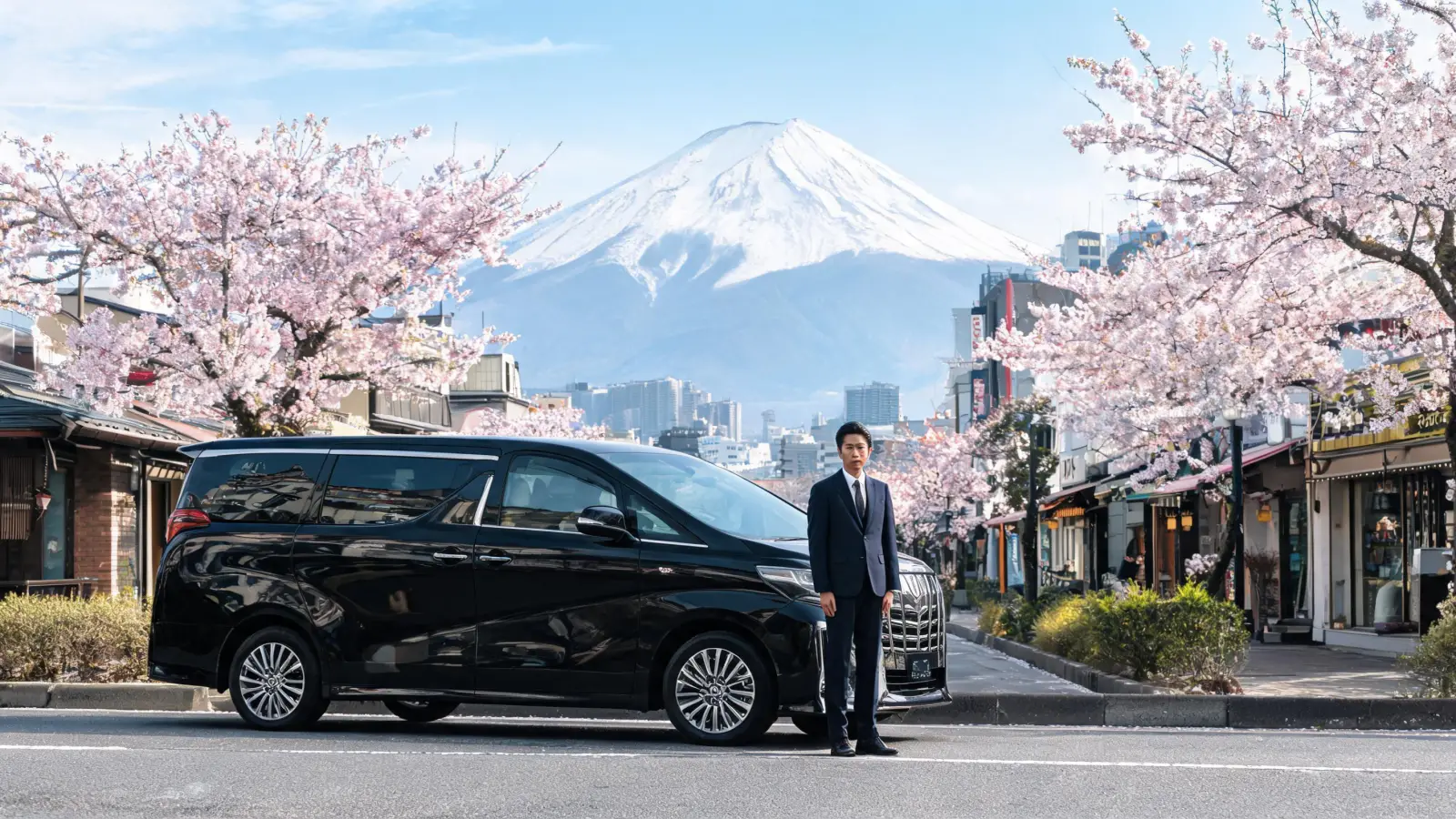
Bottom line: For a private car charter in Japan in 2026, based on 8-10 hours per day, a 5-seat economy sedan costs roughly RMB 900-1,500/day; an Alphard or other 7-8-seat van costs between RMB 1,500-2,600/day; a 10-seat Toyota HiAce costs around RMB 2,000-3,000/day; and a minibus (approx. 20 seats) costs about RMB 2,800-4,500/day. These are all-inclusive "package prices" covering a Chinese-speaking driver, fuel, expressway tolls, and parking fees. Prices tend toward the upper end in peak seasons in Tokyo, Kyoto, and Hokkaido, while they can drop closer to the lower end during off-peak periods in Osaka and Okinawa. Below, we break down each vehicle type, every variable affecting the price, and common pitfalls in one go.
How much per day for each vehicle type (RMB, with JPY reference)
Let's clarify the scope first: The "daily rate" below refers to the standard one-day charter price for 8-10 hours, within a single area, and includes the driver's attendance, fuel, ETC expressway fees, and urban parking fees. The exchange rate is roughly calculated at 1 RMB ≈ 20 JPY; the actual rate depends on the transaction date.
- 5-seat economy sedan (Toyota Camry/Crown class): Approx. RMB 900-1,500/day (approx. JPY 18,000-30,000). Suitable for 2-3 adults with light luggage; the best value choice for airport transfers or one-day city tours.
- 7-8 seat van (Toyota Alphard/Vellfire/Sienna): Approx. RMB 1,500-2,600/day (approx. JPY 30,000-52,000). The Alphard is the "top pick" for charter cars in Japan—spacious, well-insulated, easy to board and alight; ideal for families with elderly/children or small groups of 4-6 people. Prices are firmer in peak seasons.
- 10-seat Toyota HiAce: Approx. RMB 2,000-3,000/day (approx. JPY 40,000-60,000). Best value for money. Handles 7-9 people with large luggage effortlessly. The downside is lower ride comfort compared to the Alphard.
- Minibus (13-20+ seats): Approx. RMB 2,800-4,500/day (approx. JPY 56,000-90,000). Used for groups of 10+ people, ski season with equipment, or Okinawa diving gear. The exact price depends on the number of seats and vehicle age.
A word of caution: Occasionally online you'll see "Alphard 888 a day" type low prices. These are mostly illegal cabs, packages with reduced hours (e.g., only 5 hours), or bait prices that later inflate. Don't be misled by the surface numbers.
4 Key Variables Affecting Price
1. Usage Duration: Standard is 8-10 hours
The default daily charter in Japan is 8 or 10 hours (including the driver's meal break), timed from hotel pick-up to hotel drop-off. Any excess beyond the agreed duration is charged separately as overtime, typically ranging from RMB 150-350 per hour (higher for larger vehicles). Half-day charters (4-5 hours) are usually charged at 60%-70% of the full-day rate—not half price, because the driver can still only take your booking that day.
2. Regional Differences: Tokyo/Kyoto most expensive, Osaka in the middle
For the same Alphard, the price ranking is roughly: Tokyo ≈ Kyoto > Hokkaido > Osaka > Okinawa. Tokyo and Kyoto have higher labor and parking costs and strong demand, so quotes are generally 15%-25% higher than Osaka. Hokkaido has vast distances between points (often over 100 km), so although the unit price may not always be the highest, it frequently triggers "cross-region/long-distance" surcharges. Okinawa is generally more leisure-oriented, and off-peak prices are relatively moderate.
3. Season: Cherry blossom, autumn leaves, New Year, and Golden Week all raise prices
Japanese charter pricing has a very clear peak season premium. During late March–April cherry blossom season, November autumn leaves, late December–early January New Year, late April–early May Golden Week (and Chinese New Year), quotes generally increase by 20%-50%. In Kyoto during peak autumn, you may even need to book good cars 1-2 months in advance. Off-peak travel (e.g., mid-to-late May, June, September) is not only cheaper but also less crowded at attractions.
4. Driver-Guide vs. Pure Driver: One of the biggest price differences
Many people don't grasp this. A pure driver only drives safely to your destinations—no commentary, no accompanying you to attractions, no itinerary planning. A Chinese-speaking driver-guide provides commentary on history and local culture along the way, helps you book restaurants, avoids queues, recommends hidden photo spots—essentially a private tour guide. A driver-guide typically costs RMB 300-700 more per day than a pure driver, but for first-time visitors to Japan who want an in-depth experience without heavy research, this expense is often the most worthwhile. The upper end of the price ranges above are generally calculated based on "Chinese-speaking driver-guide."
What's Usually Included and Not Included in the Fee
Make sure to clarify each item when negotiating—this is key to avoiding unexpected surcharges.
The daily fee typically includes:
- Driver attendance fee, vehicle depreciation
- Fuel (gasoline)
- Expressway tolls (ETC)
- Parking fees within reasonable urban limits
- Driver accommodation and meal allowance for overnight cross-region trips (e.g., Tokyo to Hakone/Kawaguchiko overnight—you need to bear the driver's accommodation cost for one night, usually RMB 300-600/night)
The daily fee typically does NOT include, payable separately:
- Entrance fees to attractions, cable cars, boat rides, etc. (driver tickets are usually waived)
- Overtime fees (approx. RMB 150-350 per hour—make sure this is clearly written in the agreement)
- Actual consumption at restaurants, hot springs, etc. booked by the driver-guide
- Extra mileage fees for remote areas (some operators charge for exceeding a base mileage)
Japan Charter Vehicle & Daily Rate Reference Table
| Vehicle Type | Suitable number of passengers | Luggage capacity | Daily rate (RMB/8-10 hours) | JPY reference | Typical use |
|---|---|---|---|---|---|
| 5-seat economy sedan | 2-3 people | 2-3 medium suitcases | RMB 900-1,500 | JPY 18,000-30,000 | Airport transfers, city day trip |
| Alphard/Vellfire (7-8 seats) | 4-6 people | 4-6 large suitcases | RMB 1,500-2,600 | JPY 30,000-52,000 | Family trips with elderly/children |
| Toyota HiAce (10 seats) | 7-9 people | 8-10 large suitcases | RMB 2,000-3,000 | JPY 40,000-60,000 | Large groups, bulky luggage |
| Minibus (13-20+ seats) | 10-18 people | Ample / can fit ski/dive gear | RMB 2,800-4,500 | JPY 56,000-90,000 | Groups, ski/dive tours |
Note: Prices increase by 20%-50% during peak seasons (cherry blossom, autumn leaves, New Year, Golden Week). A driver-guide costs roughly RMB 300-700 more per day than a pure driver. The table is for a single area for 8-10 hours; cross-region or long-distance trips should be negotiated separately.
Practical Details: Child Seats, Luggage, Airport Transfers
- Child seats: Japanese law requires children under 6 to use a child safety seat. Reputable operators can provide them for free or a small charge (approx. RMB 30-60/seat/day). Be sure to inform the child's age/weight in advance so the correct car seat or booster can be arranged.
- Luggage capacity: Don't just count seats. When an 8-seat Alphard is full with 6 people, the trunk only fits about 3-4 large suitcases. If you have many people and lots of luggage, it's better to choose a HiAce. Be sure to mention ski/snowboard gear in winter or diving equipment in advance.
- Airport transfer timing: For pickups at Narita/Haneda/Kansai airports, the driver will monitor your flight number in real time. If your flight is delayed, there's no extra charge (within reason). But you must provide the exact flight number and estimated exit time. For departures, allow plenty of time—from central Tokyo to Narita is about 1.5-2 hours' drive.
Common Pitfalls, Explained One by One
- Illegal cabs (no operating license): This is the biggest risk. Legally operated vehicles in Japan have green license plates (green background, white characters), and taxi/charter vehicles require relevant transport permits. White-plate private cars picking up passengers for a fee are illegal operations: in case of an accident, insurance won't pay, and you could face police action. Always confirm before booking that the driver/operator holds a valid operating license and passenger insurance.
- Insurance issues: Passengers in legitimate charter vehicles are covered by commercial vehicle liability insurance. Illegal cabs typically use private car insurance, which will refuse claims in the event of an accident while carrying fare-paying passengers—you bear the consequences.
- Last-minute surcharges: Some low-price ads lure you in, then add charges after boarding like "fuel is extra," "parking is extra," or "today is heavy traffic so we need more money." Countermeasure: Before confirming, have the total price, what's included, and overtime rates clearly documented in writing.
- Opaque overtime fees: "We'll figure out overtime later" is a classic trap. Be sure to agree on how many hours base, the hourly overtime rate, and how partial hours are charged—and get it in writing.
- Driver doesn't speak Chinese but charges as "driver-guide": Clearly distinguish between a pure driver and a Chinese-speaking driver-guide. Don't pay extra for commentary that doesn't exist.
FAQ
Is chartering a car in Japan worth it compared to taxis or JR?
For groups of 3+ people with lots of luggage or wanting to visit scattered attractions (e.g., around Mt. Fuji, Hokkaido, Kyoto outskirts), chartering is usually cheaper and less hassle than taking taxis segment by segment. For 1-2 people along main city routes, JR and subways are more cost-effective. With elderly/children or a tight schedule, chartering is almost the best option.
Why is the Alphard more expensive than the HiAce? Which should I choose?
The Alphard offers superior comfort, luxurious seats, and better sound insulation—ideal for 4-6 people prioritizing comfort. The HiAce has more space and luggage capacity at a lower price, making it suitable for 7-9 people or those with lots of luggage. If you have fewer people but want a nicer ride, choose the Alphard; if you need practicality for a larger group, go with the HiAce.
Do I need to tip the driver?
Japan has no tipping culture, and charter drivers do not expect tips. If you're satisfied, a small token of appreciation or buying the driver a drink is fine—no pressure.
How far in advance should I book?
For normal seasons, 1-2 weeks ahead is enough. For peak seasons like cherry blossom, autumn leaves, Golden Week, and New Year, book 1-2 months in advance, as good cars and experienced driver-guides are in high demand—waiting until the last minute often leaves you with expensive or no availability.
How are cross-region itineraries (e.g., Tokyo to Hakone/Kawaguchiko overnight) charged?
Cross-region trips are usually charged by adding daily rates for each day and additionally covering the driver's accommodation (approx. RMB 300-600/night) and meal allowance. Long distances may trigger a mileage surcharge—clarify all this during negotiation.
How can I confirm the operator isn't an illegal cab?
Check whether the license plate is green, ask to see the operating license and passenger insurance, verify the vehicle model and plate match what was agreed, book through a reputable platform, and keep records of all chats and price quotes. If the license is vague, the operator only deals privately, or the price is ridiculously low, walk away.
Don't want to get bogged down by individual quotes? Let local driver-guides compete for your booking
The reason charter prices are so confusing is that the same car can vary by 30-40% between different operators and drivers, making it hard to judge what's reasonable. Instead of asking around and being lured by low-ball prices, try the reverse approach: post a car request on 地接侠 (Dijiexia) (specify date, number of people, luggage, places you want to visit, whether you want a Chinese-speaking driver-guide), and let local licensed driver-guides proactively bid with their quotes. You can compare multiple quotes, the driver's qualifications, and real reviews side by side. After selecting, pay a deductible deposit to lock it in. Prices are transparent, responsibilities are clear, and there's no room for illegal cabs or last-minute surcharges. Let the platform handle the negotiation and vetting—you just enjoy your trip.