
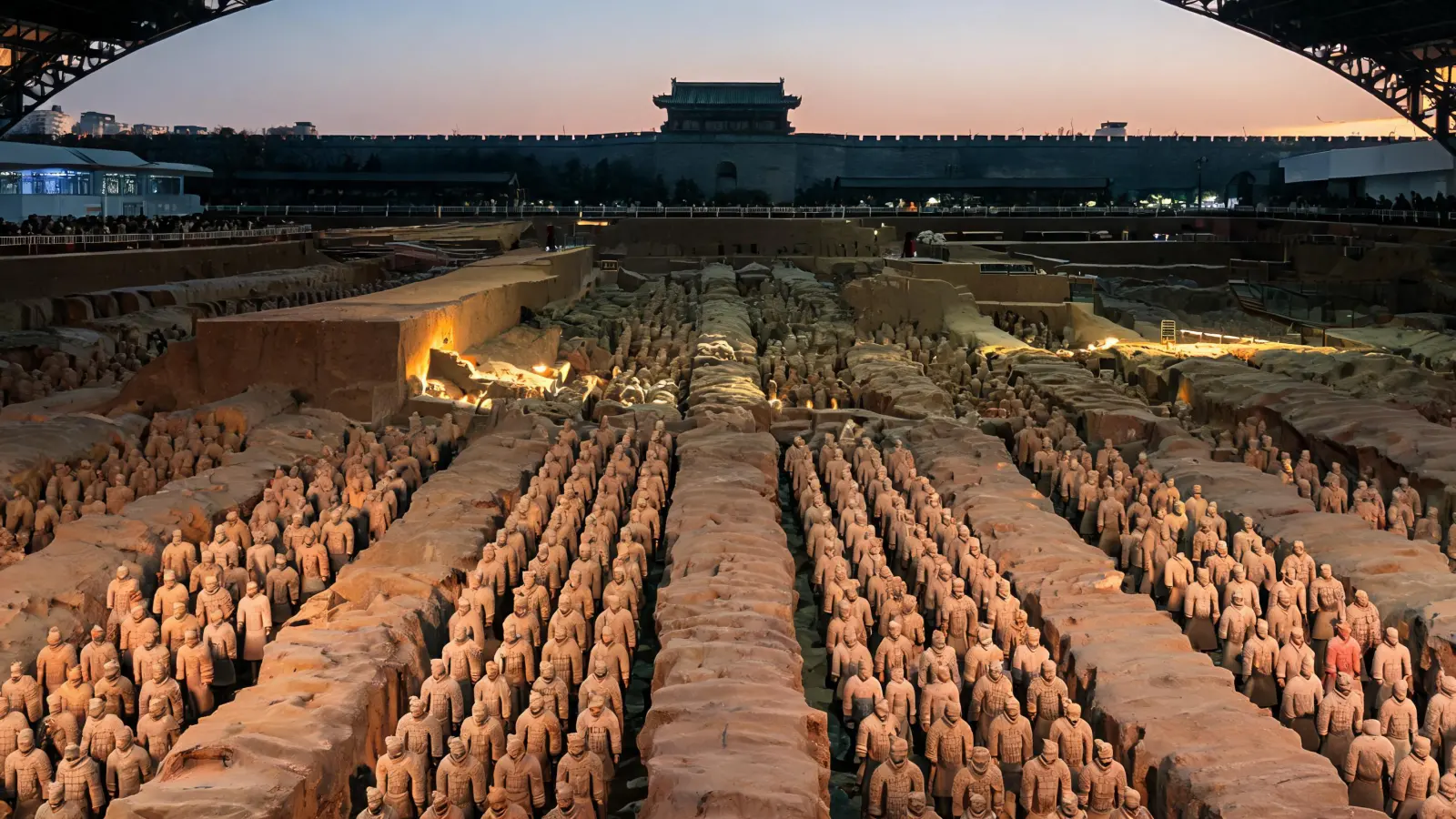
One-sentence conclusion: Don't visit the Terracotta Warriors without a plan. The Lintong area (Terracotta Warriors + Huaqing Palace + Mount Li) is about 40 km from the city center. The most hassle-free approach is to spend 2 days in the city (City Wall, Muslim Quarter, Giant Wild Goose Pagoda, Shaanxi History Museum) plus a separate day for a private car trip to Lintong. Book your Terracotta Warriors and Shaanxi History Museum tickets in advance using your real name on official platforms. Foreign travelers should bring their passport for ticket purchase and hotel check-in, and link a foreign card to Alipay/WeChat International. In 3 days, you can thoroughly experience Xi'an's "Qin, Han, and Tang" heritage.
How many days should you spend?
Xi'an's core layers are "the Ming and Qing ancient city inside the wall, the Han and Tang relics outside the city, and the Qin dynasty in Lintong." The sights aren't scattered, but each deserves time. Here's a practical day count:
- 2 days: The minimum to cover either "city highlights" or "Terracotta Warriors" without missing out. Day 1: City Wall, Muslim Quarter, Bell & Drum Towers. Day 2: Private car to Lintong for Terracotta Warriors + Huaqing Palace. You'll have to skip the Shaanxi History Museum. Suitable for transit travelers or those only here for the warriors.
- 3 days: The sweet spot. Two days for a relaxed city tour (including Shaanxi History Museum, Giant Wild Goose Pagoda, Tang Paradise Night City), and one dedicated day for Lintong. Most people choose this option.
- 4 days or more: Add a day trip to the outskirts – Mount Huashan (for thrilling hikes) or Hukou Waterfall (for grandeur). Pick one, as each requires a full day round trip.
Note: The Terracotta Warriors and Shaanxi History Museum are located east and south of the city respectively, and their routes don't align. Squeezing them into one day means rushing and a poor experience. Better to split them across days.
Must-see attractions
Terracotta Warriors and Huaqing Palace (Lintong, often visited with a private car day trip)
The Terracotta Warriors (Emperor Qinshihuang's Mausoleum Site Museum) are Xi'an's "can't-miss" sight. The three pits, especially Pit 1, are awe-inspiring. Peak season tickets cost about 120 yuan / off-season around 90 yuan (includes the museum and Lishan Garden at the mausoleum site, subject to official on-site rates). Online real-name reservation is mandatory; tickets often sell out same-day during peak season, so book well in advance via official channels. Arrive right when it opens (around 8:30 AM) or late afternoon when crowds thin out to avoid the midday tour groups. A guide is essential – without one, you'll just see "a bunch of clay figures"; with one, you'll understand the details of kneeling archers, general figurines, and chariot formations.
Also in Lintong is Huaqing Palace (about 120 yuan, subject to official rates), a hot spring palace for Emperor Xuanzong and Yang Guifei, and the site of the Xi'an Incident. It sits at the foot of Mount Li, accessible by cable car. Lintong is about 40 km from the city center. Metro Line 9 + bus can get you there, but linking the Terracotta Warriors, Huaqing Palace, and Mount Li by taxi or transfer is cumbersome. Most visitors opt for a private car day tour to connect these three spots smoothly, avoiding the hassle of waiting under the sun.
Xi'an City Wall and Bell & Drum Towers
The Ming City Wall is the best-preserved ancient city wall in China, about 13.7 km in circumference. Admission is about 54 yuan (subject to official rates). The best way to experience it is to rent a bike and cycle the full circuit (single/tandem bikes have additional fees and deposits), taking about 1.5–2 hours. Go up just before sunset for the most beautiful views of the sunset and the city lights coming on. The Bell Tower and Drum Tower stand at the city center; the Bell and Drum Tower Square is lovely at night. The Muslim Quarter begins right under the Drum Tower. Spend 1–2 hours here.
Muslim Quarter and Yongxingfang
The Muslim Quarter is the most famous food hub, lively but the main street is very touristy with inflated prices and some dishonest stalls. Savvy eaters head to the side alleys (like Dapiyuan and Sajinqiao) where locals eat breakfast. Yongxingfang is a restored ancient-block area that gathers snacks from all over Shaanxi (where the "wine bowl smash" trend went viral). It's more organized and good for a one-stop food tour. Both are free to enter. Eat according to your appetite – don't fill up on a single main street.
Giant Wild Goose Pagoda and Tang Paradise Night City / Tang Paradise
The Giant Wild Goose Pagoda is where Xuanzang translated Buddhist scriptures, a Tang dynasty landmark. Daci'en Temple costs about 50 yuan, with an additional fee to climb the pagoda (subject to official rates). The north and south squares are free; the North Square Music Fountain has scheduled shows (check on-site timings). Adjacent Tang Paradise Night City is a free pedestrian street with Tang-style lights and street performances (like the "Unsteady Lady"), making it Xi'an's top night-time attraction. Visit after dark. Further south, Tang Paradise is a paid theme park (about 120 yuan, subject to official rates) with a large water curtain movie show at night. Add it if you have extra time.
Shaanxi History Museum (reservation required)
"Give me one day, I'll give you 10,000 years" – this museum is the key to understanding Xi'an and ancient Chinese history. The basic exhibition is free but requires a real-name reservation in advance on the official WeChat account/mini-program. Tickets are released daily and sell out instantly – among the hardest to snag in Xi'an. Be sure to book the moment they drop. Inside, the Hejiacun Treasure and Tang Dynasty Mural Gallery are paid special exhibitions, highly recommended. Without guidance, you'll just skim. Rent an audio guide or hire a guide – worth it. If you can't get a ticket, check the new branch (Qinhan Museum) as an alternative.
Mount Huashan / Hukou Waterfall (outskirts)
Mount Huashan is the "most dangerously steep mountain under heaven," about 120 km from Xi'an. High-speed train (30 minutes) to Huashan North Station, then a tourist bus. Cable car (West/North Peak) one-way about 80–140 yuan (subject to official rates). The Plank Walk and other attractions require separate fees. Climbing Huashan is physically demanding – either take the cable car for a light visit or prepare for a tough "night climb for sunrise." Either way, it takes a full day. Hukou Waterfall is a massive waterfall on the Yellow River in northern Shaanxi, farther from Xi'an (3–4 hours one-way by car). Best visited by private car or a 1–2 day tour. It's most spectacular during the rainy season. Both are best added only if you have extra days – don't force them in.
Classic itineraries (2/3/4 days)
- 2 days (Terracotta Warriors + city highlights): Day 1: City Wall cycling → Bell & Drum Towers → Muslim Quarter food → Tang Paradise Night City (night). Day 2: Private car Lintong tour (Terracotta Warriors + Huaqing Palace), return in the evening. Tight but covers both the warriors and the ancient city.
- 3 days (recommended): Day 1: City Wall → Bell & Drum Towers → Muslim Quarter / Yongxingfang. Day 2: Shaanxi History Museum (morning reserved slot) → Giant Wild Goose Pagoda → Tang Paradise Night City (night). Day 3: Private car Lintong tour (Terracotta Warriors + Huaqing Palace + Mount Li). Relaxed and balanced – the most popular option.
- 4 days (add outskirts): On top of the 3-day itinerary, Day 4: choose one – Mount Huashan (high-speed train round trip) or Hukou Waterfall (private car/tour group). Pick Huashan for adventure, Hukou for river spectacle.
Transportation, tickets, and costs (metro, airport to city, Terracotta Warriors round trip, RMB)
Airport to city: Xi'an Xianyang International Airport (XIY) is about 40 km from the city center. The airport intercity rail/metro connects directly to the city (40–60 minutes). Airport buses have multiple routes into the city (about 25–30 yuan). A taxi costs about 100–120 yuan (subject to actual rates).
City transport: The metro network is fairly extensive, covering key points like Bell Tower, Giant Wild Goose Pagoda, and North Railway Station. A single trip costs 2–7 yuan. Foreign tourists can use the Alipay/WeChat "travel code" to scan through gates without buying a physical card; cash payments are also accepted.
Terracotta Warriors round trip: The cheapest way is Metro Line 9 to Huaqingchi/Qinling then transfer to a bus, but involves multiple transfers and waiting in the sun. There are direct bus lines from the train station/North Railway Station to the Terracotta Warriors. If you want to avoid hassle, have a larger group, or are traveling with elders/children, a private car day tour connecting the Terracotta Warriors–Huaqing Palace–Mount Li route is much more convenient.
Approximate costs (per person/day, for reference only, actual may vary): Tickets about 100–250 yuan, city transport about 20–40 yuan, meals about 60–150 yuan. A private car Lintong day tour is charged per vehicle, more cost-effective when split among multiple people. Overall, Xi'an offers good value as a tourist city.
Food (roujiamo / yangrou paomo / biangbiang noodles)
- Roujiamo (meat in a bun): Braised pork belly stuffed in a crisp flatbread – the "Chinese hamburger." Look for proper braised pork; the bun should be crispy outside and soft inside.
- Yangrou paomo (lamb soup with bread): Locals tear flatbread into small bits (size of soybeans) before it's boiled in broth – the finer, the more flavorful. Served with pickled garlic and chili sauce. Foreign visitors can ask the restaurant to pre-tear the bread or try the "fried version" (chao paomo) for an easier experience.
- Biangbiang noodles (belt noodles): As wide as a belt. The un-writable "biáng" character is a Xi'an icon. Tossed with sizzling chili oil – incredibly fragrant.
- Other must-tries: Liangpi (cold noodles), Hulatang (pepper soup), Huluji (fried chicken), Zenggao (steamed rice cake), Jinggao (mirror cake), Jia San soup dumplings. For breakfast, meatball hulatang + youcha mahua (fried dough in tea) is a classic local start.
Tip: Long lines at main street网红 (internet-famous) shops don't guarantee the best food; older shops in local alleys are often more authentic and affordable. Plenty of halal options make it easy for travelers with different dietary needs.
Practical tips and pitfalls to avoid
- Illegal guides and fake day tours at the Terracotta Warriors: At the train station or near the site, people often tout "direct buses/free guides," which actually lead to fake attractions like "World's Eight Wonders Museum" or "Hongmen Banquet Site" for shopping. Only use the official Emperor Qinshihuang's Mausoleum Site Museum ticket booth and visitor center. Hire legitimate guides through official on-site channels. For private car day tours, use a reputable platform and get a clear written itinerary stating no shopping stops.
- Book ahead – mandatory: Both the Terracotta Warriors and Shaanxi History Museum require real-name reservations that often sell out instantly. Scramble for tickets a few days before your visit on official channels – don't show up hoping for luck.
- Peak season crowds: During May Day, National Day, and summer vacation, crowds are massive. Go early or off-peak; wear sunscreen and stay hydrated – Xi'an summers are very hot.
- Foreign tourists – visa-free policies: China offers unilateral visa-free and transit visa-free (stay duration subject to policies) convenience for certain nationalities. Eligible countries, stay periods, and ports of entry are subject to the latest official announcements from Chinese authorities. Verify whether your nationality qualifies before traveling.
- Foreign tourists – ticket purchase and hotel check-in: Use your passport to purchase real-name tickets and check into hotels. Confirm with the hotel in advance that they "accept foreign guests" to avoid being turned away.
- Foreign tourists – mobile payments: Xi'an relies heavily on mobile payments. We recommend linking Alipay (Alipay) or WeChat (Weixin) International to an overseas bank card in advance. Then you can scan QR codes for the metro, meals, and tickets. Also carry a small amount of cash as backup.
- Foreign tourists – navigation and language: English signage is limited. Save offline maps and install a translation app. Keep addresses in both Chinese and English as screenshots. Metro announcements include English; ask younger people or tourist service counters for directions.
Should you hire a local guide or private driver?
It depends on your situation and where you get stuck:
- Domestic independent travelers: If you want a stress-free visit to the Terracotta Warriors but fear illegal guide scams, a private car for Lintong/Mount Huashan (with a driver-guide) is worth it – it avoids touts and shopping traps, smoothly connects the Qinling–Lishan route, and lets you learn the history of "Qin unification," Huaqing Pool, and the Xi'an Incident along the way. Much better than struggling with public buses.
- Inbound foreign tourists: Language barriers, ticket booking, ordering food, and mobile payments are often real obstacles. An English-speaking local guide or bilingual driver-guide can help with reservations, hotel communication, restaurant ordering, and explaining artifact backgrounds – they tear down the "language wall" and turn your trip from "stuck at every turn" to "smooth sailing."
Both types of travelers can post their needs on 地接侠 (Dijiexia) (including dates, number of people, desired attractions, whether an English/specific language is needed, and whether a private car is required). Local guides/driver-guides will bid and quote; you compare credentials, reviews, and prices before finalizing. Your contact info and personal details are masked until you agree – much more reliable than hiring someone on the street. Choose based on your needs, no pressure.
Frequently Asked Questions (FAQ)
- Can I buy Terracotta Warriors tickets on the day at the site? Almost impossible during peak season. The Terracotta Warriors use an online real-name reservation system; popular time slots often sell out in advance. Be sure to book via official channels ahead of time and bring the ID document used for purchase.
- How do I reserve the Shaanxi History Museum? Why can't I ever get a ticket? The basic exhibition is free but requires a real-name reservation on the official WeChat account/mini-program. Tickets are released at fixed times and sell out instantly. Try to book right at the release moment, or consider paid special exhibition tickets, or the new branch (Qinhan Museum) as an alternative.
- For foreign tourists visiting Xi'an, how do visa and mobile payments work? Check whether your nationality qualifies for China's unilateral visa-free or transit visa-free policies; refer to the latest official announcements. For payments, link Alipay or WeChat International to an overseas bank card in advance to scan codes everywhere. Use your passport for real-name ticket purchases and hotel check-in. Carry some cash as a backup.