
Bottom line: Munich is the essential hub of Bavaria—spend two to three days in the city to properly see the Old Town, the Residenz, museums, and beer halls, but the real reason to come is to use it as a springboard for Neuschwanstein Castle, the Alpine foothills, and the world’s largest beer festival in late September/early October. Give yourself 4 days to explore Munich at a relaxed pace while also dedicating a full day to Neuschwanstein without feeling rushed.
How many days should you spend?
For central Munich alone, the Old Town plus the Residenz and one or two museums can be comfortably covered in two days. The catch is most travelers come not just for the city but for Bavaria’s entire region: an hour south are the Alps and fairy-tale castles, to the east is Salzburg (Austria), and to the north is Nuremberg. My suggestion is to split your plans by goal:
If you only want to see the city and are short on time—2 days, filling them with the Old Town and one must-see museum. To add the nearby highlight of Neuschwanstein Castle—3 days, leaving a full day for a round trip to Füssen. To stretch out comfortably, add a town or mountain area around Munich, or if you’re visiting during Oktoberfest and want to spend extra evenings in beer halls—4 days or more. During Oktoberfest, crowds, long queues, and heavy traffic mean all plans need to be scaled back; better to schedule less.
Must‑see attractions
Old Town: Marienplatz, Glockenspiel at the New Town Hall, and Viktualienmarkt
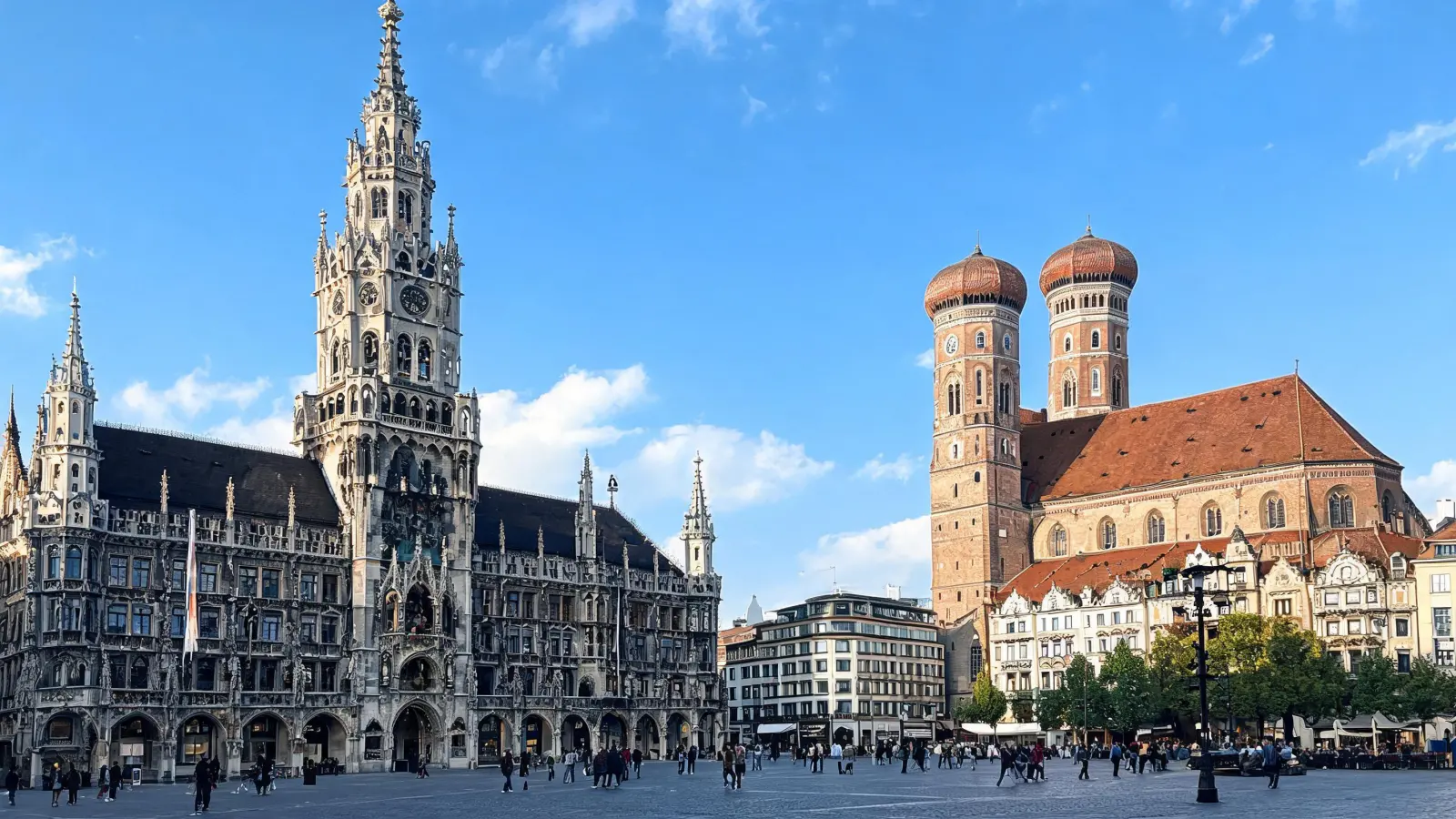
Marienplatz is Munich’s absolute center—all subway lines converge here, making it the easiest starting point on your first day. The dark green, highly ornamented Neo‑Gothic building on the north side is the New Town Hall, famous for its Glockenspiel on the front tower: daily at 11:00, 12:00 (and 17:00 in summer), life‑sized painted wooden figures rotate out to re‑enact a 16th‑century noble wedding and a craftsmen’s dance, lasting about ten minutes. Honestly, the show itself is a bit lengthy, but the atmosphere of the whole crowd looking up together is fun—once is enough. You can take an elevator up the New Town Hall tower for a panoramic view over the red‑tiled old town; good value for money.
A short walk southwest from the square leads to the Viktualienmarkt, an open‑air market where locals actually buy groceries, sausages, and cheese, and enjoy their first beer of the day. It’s far more down‑to‑earth than any tourist attraction. There’s a beer garden in the middle of the market—grab a beer and a weisswurst to eat standing up; it’s the fastest way to experience local life. Nearby, the Frauenkirche with its twin onion‑domed towers is Munich’s skyline icon—entry is free.
Residenz and Schloss Nymphenburg
The Munich Residenz was the seat of the Wittelsbach dynasty for centuries, located at the northeast corner of the Old Town. It’s so vast you can spend half a day there; the treasury’s collection of crowns, tableware, and ivory carvings is incredibly dense—lovers of courtly art won’t want to leave. If you’re pressed for time, at least see the treasury and the rococo Cuvilliés Theatre.
To the west of the city, Schloss Nymphenburg is the summer palace. Its baroque facade stretches horizontally with great grandeur. Highlights are the “Gallery of Beauties” hung with portraits of beautiful women, and the extensive French gardens where you can stroll for free. It’s a bit of a distance from the city center; take a tram there, and set aside a half‑day on its own—don’t try to squeeze it into your Old Town day.
Englischer Garten
The Englischer Garten is larger than New York’s Central Park and serves as Munich’s living room for strolling, sunbathing, and lounging on the grass. Two highlights: the Chinese Tower beer garden, packed with locals on summer evenings, and the man‑made river rapids near the entrance where surfers ride a stationary wave year‑round—a strikingly photogenic contrast. When you’re tired from sightseeing, this is the perfect place to unwind; admission is free.
BMW Welt and Museum
Munich is a museum powerhouse. Car enthusiasts shouldn’t miss BMW Welt (free exhibition cars) and the BMW Museum (paid), located next to the Olympic Park—it’s thrilling to see the brand’s history and concept cars. If you prefer technology and industrial history, the Deutsches Museum is one of the world’s largest science and technology museums, featuring real airplanes, submarines, and a full‑scale mine exhibit—you could spend half a day there. Art lovers should head to the “Pinakothek trio” (Alte, Neue, and Modern galleries). Choose just one according to your interest; don’t try to do too many.
Day trip: Neuschwanstein Castle
Schloss Neuschwanstein is the real reason many travelers come to southern Germany—the inspiration for Disney’s castle, perched amid lakes and mountains at the foot of the Alps. It’s not in Munich but near Füssen, about two hours southwest by train. The interior can only be visited on a guided tour at a fixed entry time, and you must walk or take a shuttle from the ticket office up the hill; allow plenty of time from the town to the castle just for walking. Tickets sell out easily during peak season and Oktoberfest, so advance booking of a time slot on the official platform is strongly recommended. Marienbrücke (Mary’s Bridge) offers the best photo of the castle façade, but the bridge is narrow and crowded, and it closes in bad weather. The entire round trip plus the tour will take a full day—it’s the most worthwhile and most planning‑intensive part of any Munich itinerary.
Oktoberfest (seasonal)
Munich’s Oktoberfest usually starts in mid‑to‑late September and runs through the first weekend in October, held on the Theresienwiese meadow. It’s not just drinking beer—it’s a giant amusement park plus a dozen beer tents that seat thousands, with locals in lederhosen and dirndls, live bands, roast chicken, and giant pretzels forming a complete carnival. Important points: entry to the tents is free, but popular tents are extremely hard to get a table—reserve tent tables months in advance; beer is sold by the Maß (one‑liter mug) at a fairly high price; if you come outside the festival period, you’ll miss it entirely and have to settle for regular beer halls. This is a strictly time‑limited experience—either plan your trip around it, or choose another month to avoid the crowds.
Classic itineraries (including Neuschwanstein)
1 day (Old Town highlights): Morning: Marienplatz to see the Glockenspiel, climb the New Town Hall tower, visit the Frauenkirche. Lunch: weisswurst and beer at Viktualienmarkt. Afternoon: the Residenz treasury. Evening: Englischer Garten to watch surfers, finish at a beer garden. All by subway + walking; moderate pace.
2 days: Day 1 same as above. Day 2 morning: Schloss Nymphenburg + gardens. Afternoon: choose one museum according to interest (Deutsches Museum or BMW Welt). Evening: back to the Old Town for a classic beer hall meal of pork knuckle.
3 days (including Neuschwanstein): First two days cover Munich in depth; day 3 fully devoted to Neuschwanstein—depart early for Füssen, visit the castle and Marienbrücke in the afternoon, then return. If you buy a Bayern‑Ticket, it’s the most cost‑effective way for this day trip. If you have energy and want to add more, you could do the surrounding area on day 2 and leave day 3 for the Alps or Salzburg.
Transportation, tickets & costs
City transportation uses the MVV system (U‑Bahn, S‑Bahn, trams, and buses with a unified ticket). The most common way from the airport to the city center is the S‑Bahn (S1/S8 lines), about 40 minutes to Hauptbahnhof or Marienplatz, much cheaper than a taxi. For multiple days in the city, buy day passes or group day passes (a group pass shared by several people is very cheap per person). Approximate prices: single ticket from €3.90, city day pass around €9–10 (roughly 70 RMB, subject to official rates).
For cross‑city day trips like Neuschwanstein, the Bayern‑Ticket is a great deal: valid from 9 am on weekdays and all day on weekends/holidays for unlimited regional trains and local transit across Bavaria, with a small extra fee per additional person; single version from about €29, up to 5 people (roughly from 230 RMB, subject to Deutsche Bahn official pricing). Two or three people going to Füssen together will save substantially compared to buying individual tickets.
Attraction ticket prices: New Town Hall tower, Residenz, Nymphenburg, and museums mostly range from a few euros to around €15–20; Neuschwanstein tickets are about €15–20 plus a small booking fee (prices and opening times subject to the official ticket platform). Large museums like the Deutsches Museum are more expensive but offer excellent value.
Food: beer, weisswurst & pork knuckle
Munich’s cuisine is all about classic Bavarian hearty dishes. Beer comes first—Munich has its own major breweries; order a one‑liter wheat beer or helles in a century‑old beer hall with live music for the full experience. Weisswurst (white sausage) is a local breakfast item, made from veal and spices, traditionally eaten only before noon with sweet mustard and a pretzel (Brezn). The proper way is to split the sausage and remove the skin, eating only the meat inside—don’t bite straight through. Schweinshaxe (roasted pork knuckle) is a massive, filling dish—crispy crackling outside, tender inside—easily enough for two. Add roast chicken (Hendl) and giant pretzels, and you’ve got a full “beer hall combo.” Budget: a proper meal in a beer hall costs around €20–30 per person (roughly 160–240 RMB, depending on your order).
Pitfalls to avoid
Visa: Germany is in the Schengen Area; Chinese passport holders need a Schengen visa in advance. Applications and appointments should be made early—peak season slots are tight, so allow plenty of time, subject to the latest embassy/consulate requirements.
Oktoberfest accommodation must be booked extremely early: Late September to early October is the most expensive and crowded period in Munich; hotel prices can double or triple and rooms are hard to find. If you plan to come during the festival, book your room and tent tables months ahead, otherwise you may have to stay in a distant town and commute.
Neuschwanstein tickets must be booked in advance: The castle interior has limited capacity per time slot and requires a guided tour; same‑day tickets are almost impossible to get during peak season. Reserve a time slot on the official platform in advance. Also factor in the uphill walk or shuttle, and the return train—don’t cut it too close to the last departure.
Weisswurst timing and eating methods, plus Viktualienmarkt opening days are also common pitfalls: many shops and markets close on Sundays, so plan shopping and market visits for weekdays or Saturday.
Should you hire a Chinese‑speaking local guide / private driver?
Munich city transportation is well‑developed and signposted; you can easily explore the Old Town on your own using the subway—no need for a guide. The two scenarios where outside help is really worth considering are: 1) Day trips to Neuschwanstein and similar suburbs—the chain of regional train transfers, uphill shuttle, and timed castle entry can be tricky; if your time slot isn’t matched, the whole trip can be wasted. A Chinese‑speaking driver/guide who knows the route, handles door‑to‑door transport, and keeps track of your booking time can save a lot of guesswork. If you also want to combine Linderhof Palace or nearby towns into a single day, private car flexibility beats public transit. 2) During Oktoberfest—the crowds, language barriers, table reservations, and late‑night returns are more complex; having a local Chinese contact makes things much easier.
This sort of “only needed for specific legs and times, not all the time” flexibility is perfect for posting a request on LocalHero: just describe your destination (e.g., a one‑day round trip to Neuschwanstein), group size, and date, and local Chinese‑speaking guides, drivers, and interpreters will bid with offers. You compare their credentials, reviews, and prices, then decide. You only pay for that one day, without being tied to a full‑time guide for the whole trip. The parts you can manage on your own in the city, you do freely.
FAQ
Q: Do you have to start from Munich to visit Neuschwanstein? Can you do it in one day?
A: Yes, it’s a common and feasible arrangement. The regional train from Munich to Füssen takes about two hours; then you take a shuttle up the hill. A same‑day round trip is completely possible, but allow enough buffer and book a castle time slot in advance to avoid arriving with no ticket or missing the return train.
Q: If I don’t come in September/October, do I miss Oktoberfest completely?
A: The official Oktoberfest takes place only during that fixed period; you won’t find the tents and amusement park at other times. However, Munich’s Old Town has year‑round historic beer halls and beer gardens where you can still enjoy authentic beer, pork knuckle, and weisswurst in a great atmosphere—just without the festival tents and rides.
Q: How many days is Munich worth? Can it be seen in one day?
A: The pure city highlights can be rushed in one day, but it will be very hurried. At least 2 days is recommended for the city itself. Add Neuschwanstein for 3 days. If you also want to explore the surrounding area or are visiting during Oktoberfest, 4 days is more comfortable. Using Munich as a base to explore all of southern Germany offers the best value.