
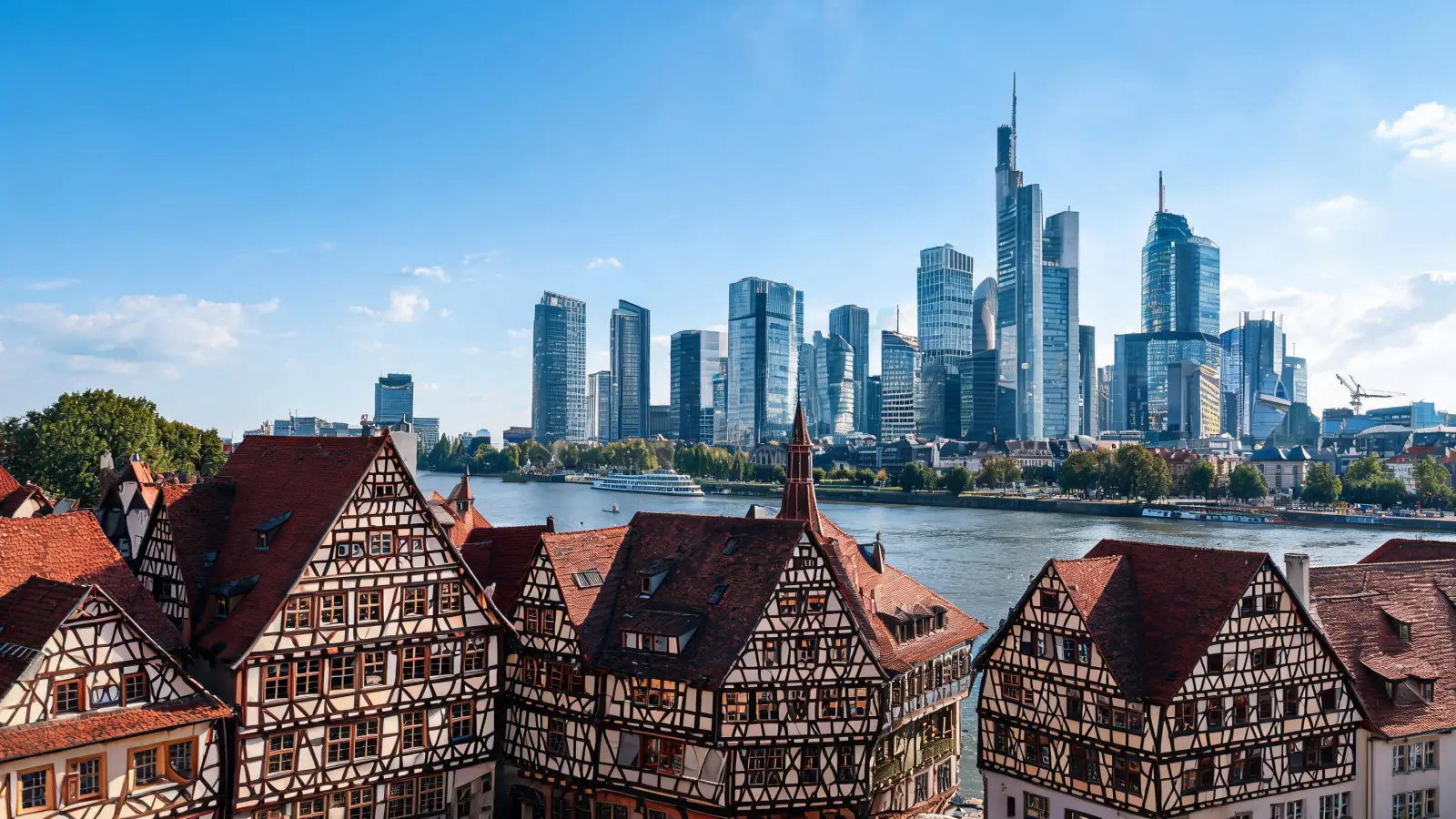
One-sentence conclusion: Frankfurt itself doesn't have many "sights"—you can cover the core area in half a day to a full day. Its true value lies in being the gateway to Germany and even Europe: one of Europe's largest transfer hubs, the crossroads of German high-speed rail, and perfectly positioned right in the center of destinations like the Rhine Valley, Heidelberg, and Cologne. So the smart approach is: use Frankfurt as your base, spend half a day in the old town, and dedicate the rest of your time to day trips in the surrounding area.
How many days to spend
If you're just in transit or on business, half a day is enough to string together Römerberg, the Cathedral, and both banks of the Main River. For a dedicated trip, I recommend 2 to 4 days: the first day in the city, then each subsequent day radiate out in one direction using Deutsche Bahn—one day for the Rhine Valley, one for Heidelberg, one for Cologne—comfortable pace with no repetition. If you only have one day, spend half a day in the old town plus climb the Main Tower, and finish off in the evening with a glass of apple wine in Sachsenhausen.
One often overlooked fact: Frankfurt is one of the few German cities with a skyline. That's because it's home to the European Central Bank and a cluster of banks, with glass-walled skyscrapers packed together—locals jokingly call it "Mainhattan." This modern feel creates a striking contrast with the old town's half-timbered houses, giving the city a unique character. Don't dismiss it as just "boring."
Must-see attractions
Römerberg: half-timbered houses and city hall
This is Frankfurt's postcard image and the starting point for almost all city itineraries. The square is surrounded by a ring of red-and-black German half-timbered houses (Fachwerkhaus). The building with the stepped gable facing the square is the Römer (city hall), which has been the municipal center for centuries. One thing to note: the old town was almost completely flattened in WWII, so most of what you see today were carefully reconstructed replicas after the war. Don't expect "thousand-year-old originals"—think of it as the Germans' dedicated restoration of their historical landscape. The fountain of Lady Justice stands in the center of the square, and during Christmas, it's home to one of Germany's most famous Christmas markets. Exploring the square is free.
Frankfurt Cathedral (Kaiserdom)
Its official name is St. Bartholomew's Imperial Cathedral, built with red sandstone. It was where the Holy Roman emperors were elected and crowned—extremely significant. Entry to the main church is free. To climb the tower (approximately 95 meters) for a view over the old town, you'll need to go up over 300 spiral steps; the ticket costs around €3–4 (about ¥24–32 RMB, check official price). From the top, the view hugs the Main River and the old town closely—a great value viewpoint.
Museumsufer (Museum Embankment) along the Main
This is my personal favorite stretch, yet it's the most underrated by tourists. Along less than a kilometer of the southern bank of the Main, you'll find a dense cluster of over a dozen museums—the Städel Museum houses European masterpieces from the Middle Ages to modern times and is one of Germany's most important art museums; there's also the German Film Museum, the Architecture Museum, the Museum of Applied Arts, and more. Even if you don't go inside, just strolling along both sides of the river and looking at the Iron Bridge (Eiserner Steg) covered in padlocks is one of the most pleasant activities in Frankfurt. Most museums charge around €12–16 per single ticket (about ¥96–128 RMB, check official price), and there's often a free admission day each month—worth checking their websites before you go.
European Central Bank and the skyline: Main Tower observation deck
For that "Mainhattan" panorama, the best spot is the 200-meter open-air observation deck at Main Tower—the only skyscraper top in Frankfurt open to the public. Tickets cost about €9–10 (approx. ¥72–80 RMB, check official price). On a clear day, you can see all the high-rises, the river, and the old town. Going in the evening lets you catch the city lights coming on. The ECB's new headquarters—the twisted twin towers—are a little farther on the other side of the river, best for a distant photo opportunity.
Zeil shopping street
Zeil is Frankfurt's busiest pedestrian shopping street, with everything from department stores to fast fashion. The MyZeil mall, with its huge canyon-like glass ceiling, is a landmark. Great for tax-free shopping and picking up supplies. Strolling is free, but note that German shops are generally closed on Sundays—don't plan your shopping for that day.
Goethe House
The great German writer Goethe was born in Frankfurt, and his birthplace has been restored to its 18th-century appearance. It was here that he wrote The Sorrows of Young Werther. Worth visiting if you're interested in literature or German bourgeois life; tickets are around €10–13 (approx. ¥80–104 RMB, check official price). If you're short on time, you can skip it and spend more time by the river.
Day trips from Frankfurt
This is the real highlight of a Frankfurt itinerary. All four directions below can be done as day trips:
Rhine Valley · Rüdesheim boat trip: About an hour by train from Frankfurt to Rüdesheim, the gateway to the UNESCO World Heritage "Upper Middle Rhine Valley." Take a KD cruise boat downstream, with steep vineyards on both sides and medieval castles perched on hilltops. Along the way, you'll pass the famous Loreley rock and gorge. In the town, the narrow "Drosselgasse" alley is lined with taverns—pair it with a glass of local Riesling. This is the classic day trip from Frankfurt, bar none.
Heidelberg: About an hour by train. Germany's oldest university town. The red sandstone Heidelberg Castle rests halfway up the hillside overlooking the Neckar River, with the old town's cobblestone streets, the Old Bridge, and the Philosopher's Walk—full of Romantic charm. Almost everyone visiting Frankfurt makes this a stop.
Cologne (Köln): A little over an hour by ICE high-speed train. Cologne Cathedral is Germany's most famous Gothic structure, with twin spires visible right as you exit the station. Entry is free; climbing the tower requires a separate ticket. Don't miss it if you love grand architecture.
Rothenburg ob der Tauber: The best-preserved medieval town on the "Romantic Road," encircled by walls with rows of half-timbered houses—like stepping into a fairy tale. It's a bit farther, requiring a transfer, about 2–3 hours one way. Better for early birds or those willing to stay overnight for a deeper experience.
Classic itineraries (1/2 day + day trips)
Half-day city tour: Römerberg → Cathedral (climb the tower if desired) → cross the Iron Bridge → stroll along the Museumsufer embankment → head back and climb Main Tower for the skyline → Zeil for shopping, then in the evening go to Sachsenhausen for apple wine.
Full-day city tour: Complete the half-day route in the morning, then spend the afternoon at the Städel Museum or Goethe House at a more relaxed pace.
Three-day recommendation: Day 1: full-day city tour; Day 2: Rhine Valley with Rüdesheim and boat cruise; Day 3: choose between Heidelberg or Cologne. Prefer nature? Go for the Rhine Valley. Prefer culture? Choose Heidelberg. Love architecture? Head to Cologne—mix and match by interest.
Transportation, tickets & costs
From the airport to the city: Frankfurt Airport (FRA) has its own train station. Take the S-Bahn (S8/S9) line—about 10–15 minutes direct to Central Station (Hauptbahnhof, abbreviated Hbf). A single ticket costs around €5–6 (approx. ¥40–48 RMB, check official price), much cheaper than a taxi (starting at around €30).
The central station is the key hub: Trains to the Rhine Valley, Heidelberg, Cologne, and Rothenburg all depart from here. I recommend staying somewhere between the station and the old town for the easiest access.
Deutsche Bahn and regional tickets: For long distances, DB uses ICE/IC high-speed trains—the earlier you book, the cheaper. Real-time fares are available on the DB website/app. If you're only traveling within Hesse for a day (e.g., to Rüdesheim or Heidelberg), look into the Deutschlandticket (Germany-wide monthly pass) or a state day ticket. Group tickets often save more money for multiple people. Exact ticket types and prices depend on the DB website.
Approximate daily budget per person (excluding intercity trains and accommodation): City transport plus one or two attraction tickets: about €25–45 (¥200–360 RMB). A day trip with round-trip high-speed rail usually runs between €60–120 (¥480–960 RMB); booking in advance can cut costs significantly.
Food
Frankfurt has two local specialties you must try. First is apple wine (Apfelwein), locally called "Ebbelwoi"—a slightly tart, mildly sparkling fermented apple wine served in a blue-grey stoneware jug called a "Bembel." The most authentic place to drink it is in the traditional taverns of Sachsenhausen's old quarter. Second is Frankfurt green sauce (Grüne Soße / Grie Soß), a cold sauce made from seven fresh herbs, yogurt, and sour cream. The classic way to eat it is over boiled potatoes and hard-boiled eggs—refreshing and tangy, even Goethe was a fan. German pork knuckle, sausages with sauerkraut are also widely available. A proper German meal costs about €15–25 per person (approx. ¥120–200 RMB, check the menu).
Pitfalls to avoid
Apply for your visa early: Germany is part of the Schengen Area. Chinese passport holders need to apply for a Schengen visa in advance. The paperwork and appointment lead times can be significant—make sure you leave enough time, especially during peak seasons.
Safety near the central station: This is the most important tip. The area to the north of Frankfurt Central Station, near the Bahnhofsviertel (station district), has a red-light district and a somewhat mixed crowd. Be especially cautious at night: avoid walking alone into side streets and keep an eye on your belongings. It's fine during the day, but when booking accommodation, prioritize the east side of the station (toward the old town) rather than directly north of the station.
Turn a layover into a half-day trip: Many people fly through Frankfurt when traveling to Europe. If you have a layover of 5+ hours, you can easily take the S-Bahn into the city, visit Römerberg, and come back—but make sure to leave enough time for customs, baggage claim, check-in, and security. Plan for at least 5–6 hours, and ideally check your luggage through to avoid re-checking. If you're not sure, don't risk it.
Sunday closures: German shops are generally closed on Sundays. Plan your shopping and errands for Monday through Saturday.
Should you hire a Chinese-speaking guide / private driver?
Getting around the city is simple—subway and S-Bahn signs are clear, so you can easily explore on your own. No need to hire anyone. Where private car or Chinese-speaking guide services really make sense is for day trips to the surrounding areas—especially places like the Rhine Valley towns or Heidelberg, where you need to move between towns and want to see everything in one day. Using public transport to Rüdesheim requires timing the boat schedules, and visiting multiple Rhine Valley towns involves even more transfers and planning. If you're traveling with elderly family, children, have a lot of luggage, or are not comfortable with the language, a private car with a Chinese-speaking driver can turn Rüdesheim, the Loreley area, and even wineries along the way into a smooth day trip—saving you the hassle of checking timetables and making transfers.
On a platform like Dijiexia (Local Guide Connect), you can directly see the credentials, past reviews, and quotes of local Chinese-speaking drivers and guides. Just post your request (e.g., "Frankfurt departure, Rhine Valley full-day private car for 4 people"), and local guides can bid with offers. After comparing qualifications, prices, and reviews, you can decide—and they can't see your private information until you accept. This is more transparent and reliable than randomly joining a group of independent travelers. A combination of self-guided city exploration and private car for day trips often offers both experience and value for money.
FAQ
Q: If I have a layover in Frankfurt, do I have enough time to see the city center?
A: Yes, if your layover is 5–6 hours or more and your luggage is checked through (no need to re-check), you can take the S-Bahn into the city, visit Römerberg and the riverbank, and return. But factor in time for customs, security, and boarding—if you're unsure, it's safer to stay at the airport.
Q: Is it worth spending several days exclusively in Frankfurt?
A: For city attractions alone, half a day to a day is enough. But using it as a base to explore the Rhine Valley, Heidelberg, and Cologne makes 2–4 days very rewarding. Its value lies in its location, not the number of sights.
Q: What's the most hassle-free way to do a Rhine Valley day trip?
A: The classic plan is to take the train to Rüdesheim, then board a KD cruise boat down the Upper Middle Rhine Valley to enjoy the castles and vineyards. If you want to see several towns or prefer an easier trip with family, a private car with a Chinese-speaking driver is even more convenient—no need to worry about boat and train timetables.