
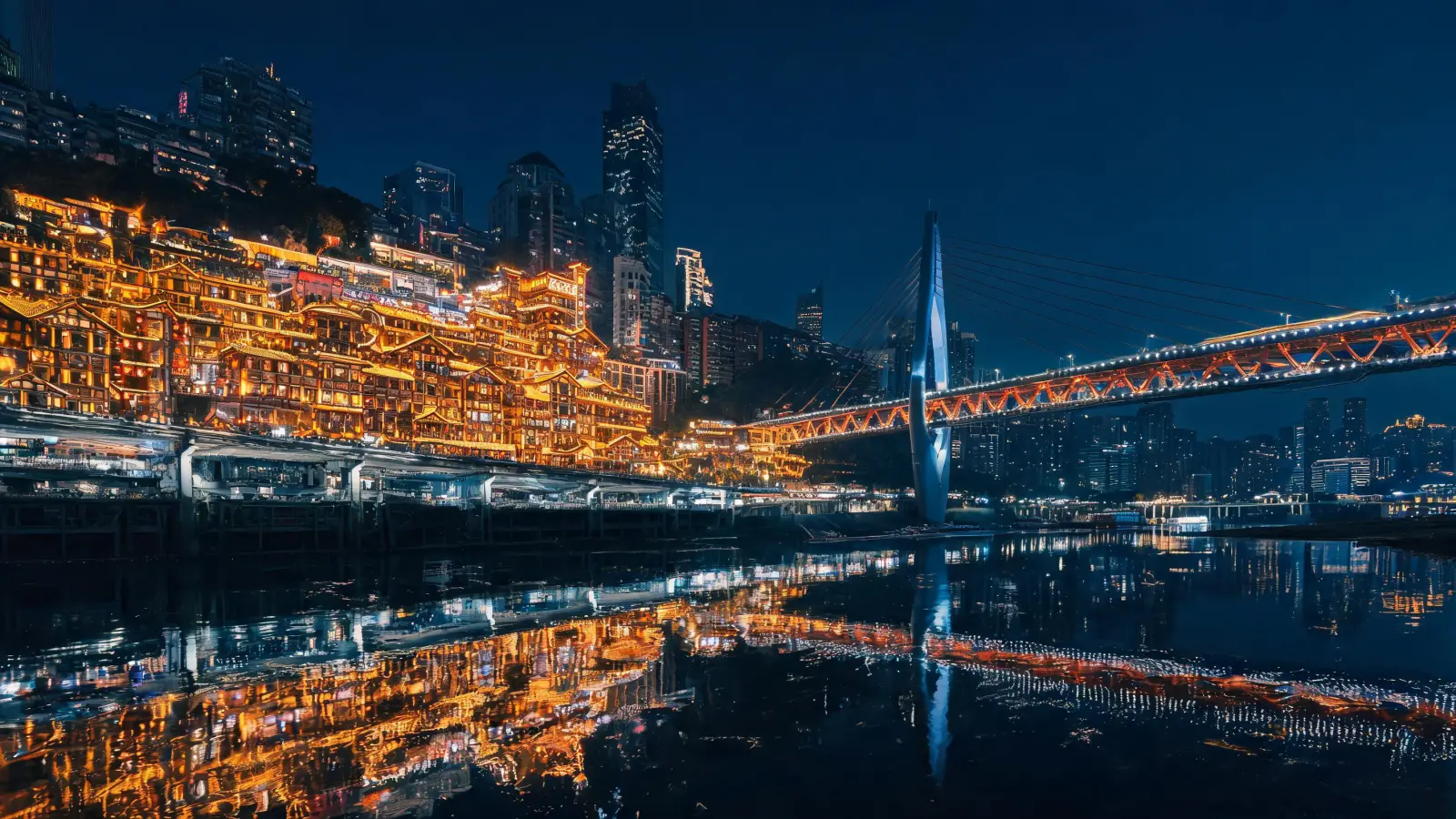
Bottom line: Chongqing is a "3D magical vertical city" built on mountains and along rivers. Two points that are 200 meters apart on a flat map can be separated by seven or eight floors in reality—which is why phone navigation often fails here. In Chongqing, judging direction isn't just about north, south, east, west; you also need to know "which floor you're on." Once you understand this, you won't get lost. If you don't, even finding the right exit from a subway station can take half an hour.
How many days should you spend in Chongqing?
For the main urban area's top attractions, 2 days is enough to cover Hongya Cave, Jiefangbei, Liziba, the Yangtze River Cableway, and Ciqikou. If you want to add Eling Er Chang and take your time eating and exploring, 3 days is more comfortable. If you plan to visit the outskirts—Wulong's Three Natural Bridges, Fairy Mountain, or Dazu Rock Carvings—each attraction takes a full day (round trip transit is at least 2 hours). So add one day per out-of-town destination to your 2–3 days in the city. For first-time visitors who want to see the most popular spots, 3 days in the city + 1 day in Wulong is the best value combo. Mountain city trails involve lots of stairs and slopes, so you'll tire faster than on flat terrain—don't overschedule.
Must-see attractions
Hongya Cave and Qiansimen Bridge night view
Hongya Cave is the star of Chongqing's nightscape. The stilted buildings clinging to the cliff are lit with warm yellow lanterns, a real-life "Spirited Away." Hongya Cave is free and open all day; lights usually come on after dark (around 18:30–22:00). The best panoramic view isn't inside the cave but from the Qiansimen Bridge or the riverbank on Jiahui Road—you can capture the lights, the bridge, and the buildings in one shot. Heads-up: entering Hongya Cave from the top floor (the street on the Jiefangbei side) actually puts you on "11th floor," and walking all the way down brings you to "1st floor" by the river—this is the classic magical experience of "going up and down 11 floors without using an elevator." Evenings are extremely crowded; if you want clear photos, try to arrive by 18:00 on weekdays.
Jiefangbei and Jiaochangkou
Jiefangbei Pedestrian Street is the main commercial hub, packed with shops, malls, and food. It's free and takes about 1–2 hours. It's a 10-minute walk from Hongya Cave, easy to combine. Nearby Jiaochangkou features old neighborhoods like Shancheng Lane and Eighteen Stairs (Shibati), giving you a taste of old Chongqing's layered stair-street texture—perfect for experiencing the city's "climbing slopes and stairs" character.
Liziba Light Rail Through Building and the Imperial Crown Escalator
Liziba is the famous "light rail through building" spot—Line 2 trains pass right through the 6th–8th floors of a residential building. Riding is free (just the subway fare), and there's a purpose-built viewing platform downstairs for photos, free. Best photography spot is on the slope next to the platform and across the street; avoid direct noon sunlight. Not far away, the Imperial Crown Escalator (from Lianglukou to Caiyuanba) is a rare extra-long outdoor escalator—about 2 yuan per ride, 2 minutes long, with a vertical drop of nearly 18 floors. It's a "transportation as attraction" experience in itself.
Yangtze River Cableway
A "cable car across the river" that was once a commuter tool, now a scenic icon for overlooking the two rivers and the city skyline. One-way is about 30 yuan, round trip about 40 yuan (check on-site rates), ride time about 5–7 minutes. During peak season, queues can be 1–2 hours; book a time-slot ticket online or go early. The Xinhua Road (Shangxin Street direction) side is usually less crowded than the Xiaoshizi side.
Ciqikou Ancient Town
A thousand-year-old town with ancient stone streets, famous for twists, Chen's twists, hot-and-sour noodles, and handmade candy. Free admission, open all day. It's very commercial and crowded on holidays; go in the morning and spend 2–3 hours. For quieter exploration, head to the back hills or walk along the Jialing River.
Eling Er Chang
A creative industrial park converted from the old No. 2 Printing Factory, with red brick warehouses, graffiti, indie shops, and a rooftop—filming location for "I Belonged to You." Free admission. Great for photography, coffee, and art lovers; spend about 2 hours including photo time. The rooftop offers distant city and river views.
Outskirts: Wulong Three Natural Bridges / Fairy Mountain
Wulong is about 2.5 hours' drive from the city. The Three Natural Bridges is a world-class karst sinkhole group, filming location for "Curse of the Golden Flower" and "Transformers 4." Tickets are about 95 yuan including scenic shuttle (check official prices), visit time about 2–3 hours. The valley has many stairs—watch your energy. Fairy Mountain is a high-altitude grassland pasture, great for summer escapes and winter snow. It's close to the bridges and often combined into a day trip.
Outskirts: Dazu Rock Carvings
A UNESCO World Heritage site, with Tang and Song dynasty cliff carvings. Baodingshan is the highlight. Tickets about 115 yuan in peak season (combined Baodingshan + Beishan, check official prices), about 1.5–2 hours' drive from the city. Set aside half a day to a full day. A must for history and Buddhist art lovers; guided commentary greatly enhances the experience—rent an audio guide or hire a guide.
Classic routes (2-day / 3-day)
2-day urban highlights:
Day 1 (Upper city) – Jiefangbei → Jiaochangkou / Shancheng Lane → Yangtze River Cableway (river crossing for views) → evening Hongya Cave → Qiansimen Bridge for night photos → late-night hotpot near Jiefangbei.
Day 2 (Railway magic line) – Liziba Light Rail Through Building → Imperial Crown Escalator → Ciqikou Ancient Town (lunch + shopping) → afternoon coffee at Eling Er Chang with river view → return.
3-day with outskirts: Add Day 3 to the 2-day plan: pick one outskirt – for natural wonders go to Wulong Three Natural Bridges + Fairy Mountain (recommend a day tour or private car, early out late back); for history/culture go to Dazu Rock Carvings. If you want both, add another day to make it 4 days.
Transportation, tickets, and costs
Chongqing relies on rail transit (subway/light rail). Lines 2 and 3 themselves are "sightseeing lines" passing through buildings, over rivers, and through mountains, covering almost all popular spots. Strongly recommend using the metro. Single ride about 2–7 yuan based on distance; get a transit card or scan on your phone. Due to the complex terrain, taking a cab often confuses both driver and passenger with the navigation, and traffic jams are bad during peak hours; take the metro when possible.
What makes this city special: the ground is layered. The same subway station may have exits leading to different floors and streets; follow the "floor signs" inside the station rather than your phone map. For tickets: most urban core attractions (Hongya Cave, Jiefangbei, Ciqikou, Eling Er Chang, Liziba) are basically free; main costs are the Yangtze River Cableway and the outskirts (Wulong, Dazu). Overall, per person per day in the city costs about 200–400 yuan for food, transport, and activities (excluding major accommodation and outskirt tickets), and you can spend more or less. All prices are subject to official and on-site listings.
Food
Coming to Chongqing without eating is like not coming at all. Hotpot is the soul – red chili oil, nine-grid pot, with tripe, duck intestines, yellow throat, and pork brain as classics. If you're afraid of spice, order a yuanyang (half spicy, half mild) pot. Local hotpot joints are often hidden in residential buildings or under overpasses—they may look unremarkable but taste authentic. Chongqing small noodles (xiaomian) are the top breakfast: spicy, numbing, fragrant, with a base serving of two liang (100g). Street-side "fly restaurants" are usually better than chains; also try pea-and-minced-pork noodles and beef noodles. Jianghu dishes (wildly spicy dishes) are another side of Chongqing: spicy chicken (lazi ji), mao xue wang, boiled fish, sauerkraut fish, "burning chicken gong," and "spring chicken"—heavy on oil and chili, generous portions, showing the locals' straightforward character. Heads-up: the local "mild (la)" might be "medium spicy" to out-of-towners—tell them your tolerance when ordering.
Practical tips and pitfalls to avoid
① Go by floor, not just by navigation. The reason navigation fails is that a flat map can't handle a layered city. When exiting the subway, finding the entrance to Hongya Cave, or crossing a bridge, pay attention to floor signs and follow the crowd; ask people directly if needed—it's faster than stubbornly staring at your phone.
② Skip peak times at popular spots. Hongya Cave, the Yangtze River Cableway, and Ciqikou are packed on holidays. Queues for the cableway can be 1–2 hours. Try weekdays, early morning, or avoid noon; book a time-slot ticket in advance for the cableway.
③ Best photo spot for the light rail through building is the designated viewing platform next to Liziba station. Trains come every few minutes; wait for a less crowded run. Avoid harsh noon light—evening light is softer.
④ Hotpot tips. Some restaurants in the Jiefangbei and Hongya Cave commercial areas overcharge tourists with mediocre taste and prices. Look for places in residential or old neighborhoods where locals line up. Watch out for hidden charges on pot base, oil dipping sauce, and minimum spend.
⑤ For overseas visitors: China offers unilateral visa waivers for certain nationalities and transit visa waivers (including 240 hours) at many ports. The specific eligible nationalities, allowed stay, and permitted areas are subject to the latest announcements by China's National Immigration Administration—verify before travel. In China, you need your passport to buy tickets, check in at hotels, and enter scenic spots—always carry it. For mobile payments, you can use Alipay or WeChat international versions linked to overseas bank cards (Visa/Mastercard, etc.) for QR code payments. It's best to register and bind before arrival. Chongqing has limited English signage and complex terrain; download offline maps and save your hotel's Chinese and English address, plus the Chinese names of key attractions, for asking directions and showing drivers.
Should you hire a local guide or private car?
It depends on your destination and needs; it's not mandatory, but in some cases it saves hassle.
Domestic tourists: The urban area is perfectly doable by metro—no need to hire anyone. But for Wulong, Dazu and other outskirts, public transit is complicated and infrequent. Private car or group carpool saves lots of time on navigation, waiting, and ticketing. Shared among a group, it's not necessarily more expensive than a tour; it's especially worthwhile for families with elderly/children or if you want to hit multiple spots in Wulong in one day. A local driver can also steer you away from tourist-trap restaurants and find authentic local eateries, which is much more reliable than navigating Chongqing's layered city with only a map.
Overseas visitors: Language barrier is the biggest issue. An English-speaking local guide or bilingual driver-guide can help you queue for tickets, handle hotel passport registration, order food safely, read Chinese signs, and navigate the "look at the floor" complexity of Chongqing, saving you a lot of wrong turns. The experience will be completely different.
Whichever type you are, you can post your itinerary requirements (dates, group size, places you want to visit, whether you need English/bilingual service) on Dijiexia, and let local guides and driver-guides bid for your trip. Compare qualifications, ratings, and prices before deciding, and your contact info will not be shared until you confirm. Letting the platform match you with reliable locals is far easier than searching from scratch in an unfamiliar city.
Frequently Asked Questions (FAQ)
Q1: What's the best time to visit Chongqing?
Spring (March–May) and autumn (September–November) offer the most comfortable weather. Summer (July–August) is famously a "furnace"—stifling and hot, but night views and mountain resorts like Fairy Mountain are still appealing. Winter is damp and cold with little snow, but city attractions remain open. Avoid the May Day, National Day (October 1–7), and Spring Festival holidays to dodge the biggest crowds.
Q2: Can I explore the city on my own without driving or joining a tour group?
Absolutely. All the popular spots are reachable by metro/light rail, with Lines 2 and 3 being sightseeing routes in themselves. Remember the three points: "look at the floor level, follow indoor signs, ask people"—your chance of getting lost drops dramatically. For outskirts like Wulong and Dazu, consider a private car or day tour only then.
Q3 (For overseas visitors): I don't speak Chinese and don't have a Chinese bank card. Can I still visit Chongqing smoothly?
Yes, but you need to prepare in advance. Before arrival, link an overseas bank card (Visa/Mastercard, etc.) to your Alipay or WeChat international version for QR payments. Always carry your passport (needed for tickets, hotel check-in, and entering attractions). Download offline maps and save the Chinese names and addresses of your hotel and key attractions. English signage in Chongqing is limited; if you want to avoid communication hassles and the difficulty of navigating, consider hiring a bilingual English-speaking local guide or driver-guide to accompany you.