
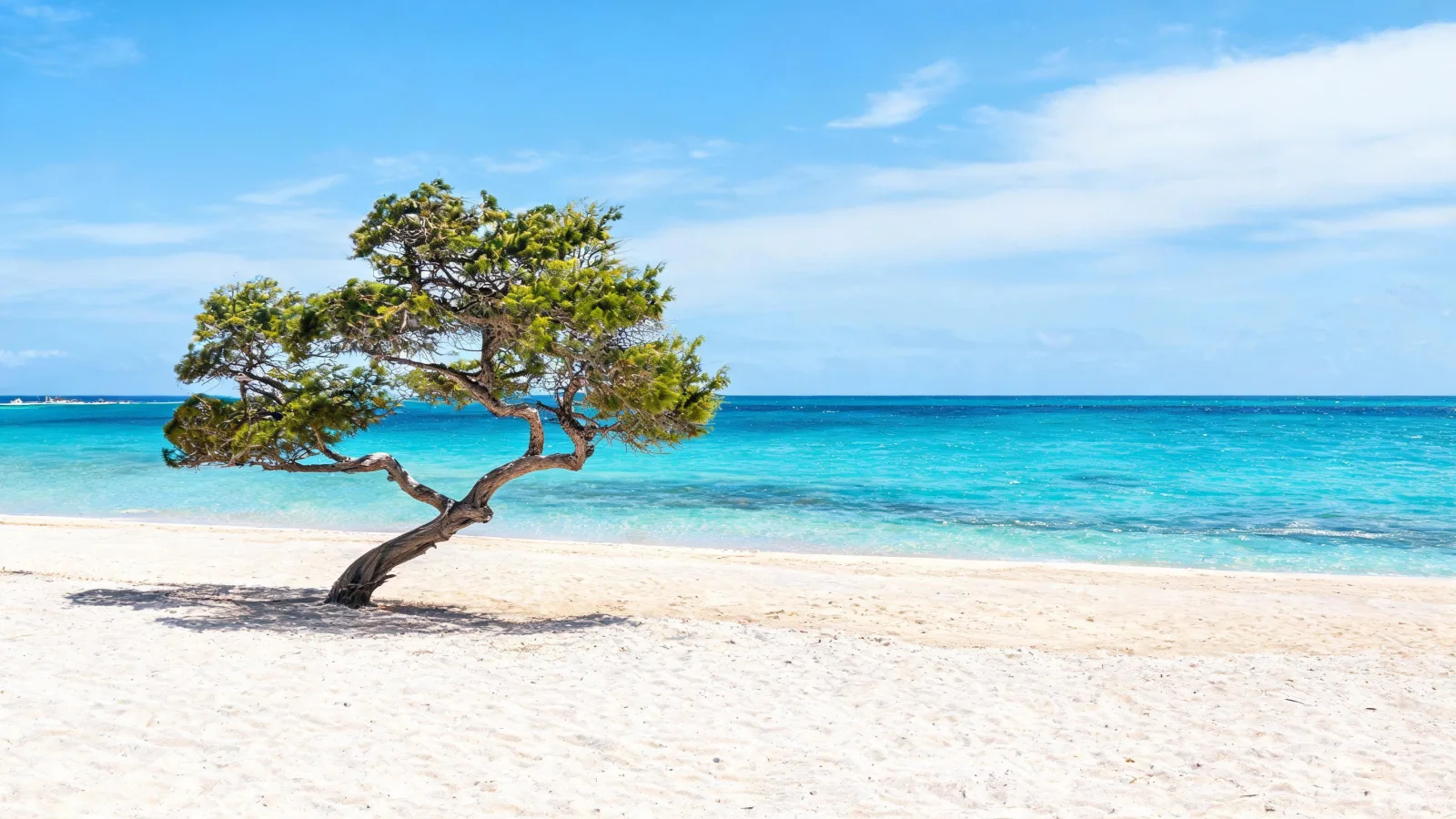
One-sentence conclusion: Aruba wins on "stability"—it lies south of the hurricane belt, with year-round dry heat and crystal-clear waters. It's a Dutch island that perfects the art of "lying flat and sunbathing." However, it's far, expensive, and the west coast resort area is highly commercialized. It's ideal for those with a generous budget who want a hassle-free island vacation and are willing to spend half a day exploring the wild east coast. It's not suitable for budget travelers or backpackers seeking untouched hideaways.
How many days to spend and when to go
Aruba covers only about 180 square kilometers, and a full loop by car is just a few dozen kilometers. The main attractions are concentrated on the west coast resort strip and the Arikok National Park on the east coast. 4 to 5 days is the sweet spot for a pure vacation: spend two or three days at Eagle Beach and Palm Beach on the west coast, arrange a snorkeling or sunset sail, and then dedicate a full day to renting a car to explore the east coast's national park and the Natural Pool. If you just want to relax and sunbathe, 3 days is enough; if you want to fully experience diving, boat trips, and island tours, 7 days won't feel too long.
Seasonally, Aruba is almost a year-round destination, with temperatures around 28°C (82°F) year-round, and the northeast trade winds keep it from feeling stuffy. The real difference is crowd levels and prices: December to April is the peak season for North Americans escaping the cold, with the driest weather but the most expensive hotels and flights, and the most crowded beaches; May to November is the off-season, with significantly lower prices and occasional brief showers that pass quickly. Aruba lies south of the traditional hurricane belt, making direct landfalls extremely rare. The so-called "hurricane season" (June to November) has far less impact here than on most Caribbean islands—but peripheral disturbances can still bring rain and rough seas. If you're concerned, just avoid the most active window of September to October.
Must-dos
Eagle Beach and Palm Beach
These are Aruba's signature beaches and the two main strips on the west coast. Eagle Beach has whiter sand, a more open coastline, and no high-rise buildings—building height restrictions mean no oppressive towers. It regularly appears on "world's best beaches" lists and is home to the two famous fork-shaped trees. It's ideal for quiet sunbathing and sunset watching. Palm Beach is the livelier version: high-rise hotels, restaurants, and water sports line up in a row. Banana boats, parasailing, and stand-up paddleboarding are readily available, and there's a bar scene at night. Choose Eagle Beach for peace, Palm Beach for convenience and fun. They're only a ten-minute drive apart, so you can easily mix it up.
The iconic Divi-divi tree
The Divi-divi (scientific name Caesalpinia coriaria) is Aruba's national tree. Constantly shaped by the strong northeast trade winds, its crown always leans southwest at a dramatic forked angle, earning it the nickname "natural compass." The two trees at Eagle Beach are the most photogenic spots on the island—best photographed in silhouette at sunrise or sunset. It's not a "scenic spot" per se; it's right by the beach, easy to visit on the way.
Oranjestad's colorful Dutch colonial architecture
Aruba is a constituent country of the Kingdom of the Netherlands. Its capital, Oranjestad, retains a rich Dutch colonial charm: candy-colored gabled facades with white trim, a duty-free street along the cruise terminal, and brilliant Caribbean sunlight make for great photos. Stroll down the main street, Caya Betico Croes, take a ride on the vintage tram, or enjoy a coffee in the square. It's also a cruise ship port, so it can get crowded when ships are in. Half a day is enough, perfect for a spare hour before a boat trip or your flight.
Arikok National Park and the Natural Pool
Covering nearly one-fifth of the island, Arikok National Park showcases Aruba's "other side": cacti, volcanic rock, wind-eroded landscapes, and indigenous cave paintings—a stark contrast to the resort vibe of the west coast, wild and awe-inspiring. The park's most famous feature is the Natural Pool (Conchi)—a calm pool of seawater enclosed by rocks, with crashing waves outside but safe swimming inside. Note: the road to the Natural Pool is a rugged, unpaved gravel path. Regular cars cannot make it; you need a 4x4 vehicle or join a UTV/jeep tour. Before driving, be sure to confirm your vehicle and park entry (the national park charges a separate admission fee).
Snorkeling, diving, and the Antilla shipwreck
Aruba's waters are clear with high visibility, making it a great spot for snorkeling and diving. The most famous site is the Antilla shipwreck, a German cargo ship sunk during WWII and one of the largest wrecks in the Caribbean. Part of the hull is close to the surface, so you can see its outline while snorkeling; certified divers can explore the interior. Additionally, the reef areas at Boca Catalina and Malmok are great for snorkeling to see fish, and Mangel Halto at the southwest tip is also popular. Most boat tours combine the shipwreck and snorkeling spots into a half-day itinerary.
Caribbean sunset sail
The sunset sail (Sunset Sail), departing from Palm Beach or the marina in the late afternoon, is a classic Aruba experience: two to three hours, including snorkeling, open bar, and watching the sun sink into the Caribbean Sea. Catamarans are steady and comfortable, suitable for families and those prone to seasickness. Book a day or two in advance during peak season, as popular boats fill up quickly.
Classic itineraries (3/5/7-day island rhythm)
3-day minimalist getaway: Day 1 arrive and check in on the west coast, sunbathe at Eagle Beach and watch sunset; Day 2 water sports at Palm Beach + sunset sail in the evening; Day 3 morning shopping at Oranjestad duty-free, depart in the afternoon. No car rental needed; taxis and hotel shuttles are sufficient.
5-day classic (recommended): Based on the 3-day plan, on Day 3 rent a car (or join a UTV tour) for a full-day trip to the east coast's Arikok National Park, Natural Pool, and California Lighthouse; Day 4 arrange a half-day snorkeling or diving trip to the shipwreck, then return to the west coast to relax; Day 5 explore the capital before departure. A balanced mix of activity and relaxation—the optimal choice for most people.
7-day deep dive/diving: Add 2 more days to the 5-day plan for systematic diving (certification or multiple dives), kiteboarding/paddleboarding, or simply slow down and alternate between beaches for long sunbathing sessions, with evenings at bars with live music.
Transportation and costs
Public transportation in Aruba includes the Arubus bus, which connects the airport, capital, and west coast resorts—cheap but limited in frequency and coverage. To visit the east coast national park and Natural Pool, renting a car is essentially the only flexible option. There are many rental agencies on the island. An international driving permit or a valid license from most countries (including a Chinese license with a translation; confirm with the rental agency in advance) is accepted. A small car is fine for general sightseeing, but you need a 4x4 for the gravel road to the Natural Pool. Drive on the right, roads are simple, and parking is mostly free.
Currency: The local currency is the Aruban florin (AWG), but US dollars are accepted everywhere. Prices, change, and credit card charges are often in USD. There's no need to specifically exchange for florins. The exchange rate is approximately 1 USD = 1.79 AWG (check current rates on site).
Costs: Aruba is generally expensive, as almost all daily necessities and food are imported. Approximate ranges (current prices apply on site): mid-range hotels on the west coast during peak season run about $250 to $450 per night (roughly 1,800 to 3,200 CNY), lower in the off-season; a meal per person costs about $30 to $60 (around 220 to 430 CNY); sunset sails are about $60 to $90 per person (430 to 650 CNY); half-day snorkeling trips to the shipwreck are about $50 to $80 per person; car rental costs about $45 to $80 per day; UTV/jeep tours are around $100 per person. Many restaurants add a 10% to 15% service charge, and there's an approximately 1.5% environmental/tourism tax—check your bill before paying.
Food
Aruba's cuisine is a fusion of Dutch, Caribbean, Latin American, and Asian influences. Must-tries include: Keshi Yena (a hollowed-out Dutch Edam cheese shell filled with stewed meat—a local signature), various fresh seafood (red snapper, lobster, conchi), street snacks like Pastechi (fried turnovers) and Dutch-style bitterballen (meatballs), and Satay (skewers) and yellow rice from Suriname/Indonesia. The local specialty condiment is Aruban hot sauce (made from Madame Janette peppers). For drinks, there's locally brewed Balashi beer and Ariba liqueur made from local cactus. Seafood is good but not cheap; restaurants on the waterfront and west coast have a noticeable markup. For more affordable eats, look for local eateries in the capital.
Things to avoid / watch out for
Long journey with a layover: There are no direct flights from mainland China. You typically need to transit through the US (Miami, New York, etc.), Amsterdam (Netherlands), or Panama City, etc. The whole trip often takes 24+ hours. Transiting through the US requires a US visa or ESTA; transiting through the Netherlands requires attention to Schengen transit rules. Be sure to research transit visa/entry requirements carefully, and tickets are not cheap—this is Aruba's biggest "entry hurdle."
Sun protection is crucial: Aruba is at a low latitude, and the trade winds can make you feel cooler than you are, leading to underestimating UV exposure. Beach sunburns are common. Don't skimp on high-SPF sunscreen, hats, and sun-protective clothing. Some areas and protected zones require coral-reef-safe sunscreen free from oxybenzone and similar ingredients—pack it before you go.
Sea conditions and safety: The west coast is calm for swimming, but the east coast (Atlantic side) has dangerous rip currents and large waves—never enter the water there outside designated areas. The Natural Pool may also close when the outer sea is rough.
High costs and big seasonal price swings: As mentioned, it's expensive, and peak season is even more so. If you're budget-conscious, avoid December to April and accept that "there are no cheap deals here." Also note the tipping culture (restaurants, tours, luggage—generally expected).
Should you hire a Chinese-speaking guide/driver?
Aruba's official languages are Dutch and the local Papiamento (Papiamento). The tourism industry widely speaks English; Spanish is also common. Chinese-language services are very scarce. For those comfortable with English who plan to just relax on the west coast, go on boat tours, and rent a car, self-service is perfectly fine—tours, car rentals, and restaurants are well-established.
However, if you struggle with English, want a hassle-free way to arrange island tours and water activities all at once, or are traveling with elderly family members or children and want a vehicle to efficiently string together Arikok National Park, the Natural Pool, the lighthouse, and the shipwreck snorkeling in a single day, then hiring a Chinese-speaking guide or private driver who knows the local roads can save a lot of communication and logistical headaches. Didijiexia is a bidding platform: you post your dates, group size, desired spots, and budget; local Chinese-speaking drivers/guides bid on your trip; you compare qualifications, reviews, and prices before deciding, with anonymized information until you commit, offering relative transparency. For a destination like Aruba—with a small language base, higher self-driving requirements (especially the off-road section to the Natural Pool), and where you'd rather spend time playing than researching—hiring a guide for a portion of the trip or a half-day often makes more sense than struggling with language and road conditions. Of course, if you're purely lounging on the west coast, don't bother—it's unnecessary.
FAQ
Q: Do I need a visa for Aruba? What's the easiest way to get there?
A: For Chinese passport holders, the specific entry policy for Aruba itself should be checked with the latest official sources. The real difficulty lies in the transit: most routes go through the US or the Netherlands, so you'll need a corresponding US visa/ESTA or Schengen transit visa. The most straightforward approach is to decide on your transit point first, then get the appropriate visa, and book the entire trip in one go. Be sure to confirm the latest rules with the embassy/consulate or airline before departure.
Q: When is the cheapest time to go? Will I encounter hurricanes?
A: Aruba lies south of the hurricane belt, making direct landfalls extremely rare. You can go year-round. To save money, choose the off-season from May to November (lower prices, occasional showers). For the driest weather, go from December to April (but it's most expensive and crowded). If you're concerned about peripheral disturbances bringing rain and rough seas, avoid September to October.
Q: Can I have a good time without driving?
A: Yes. If you're just hanging out at Eagle Beach and Palm Beach on the west coast, taxis, hotel shuttles, and boat tours are enough. However, for the east coast's Arikok National Park and Natural Pool, there's no convenient public transport, and the road to the Natural Pool requires a 4x4. If you don't drive, joining a UTV/jeep tour or hiring a car with a driver is a more hassle-free option.